Overview

Modern examples of low-temperature dolomite formation are rare, which makes Cenozoic “island dolostones” — like those on Grand Cayman and Cayman Brac (British West Indies) — one of the best natural laboratories available for testing how carbonate geochemical proxies hold up during dolomitization. These platforms are young, shallowly buried, and still host active groundwater systems, so the diagenetic fluids responsible for dolomitizing them can be directly characterized rather than inferred.

A well-documented dolomitization front on Grand Cayman gives an unusually clean version of this test. Using carbonate clumped isotopes (Δ47), dolostones along the platform periphery return a formation temperature of 19.1 ± 1.4°C from a fluid with δ18OFLUID = 0.2 ± 0.5‰ VSMOW — indistinguishable from normal modern seawater. Petrographically, the dolomite crystals are clean and well-ordered. By any standard, this is about as close to textbook, low-temperature marine dolomitization as the geological record offers.

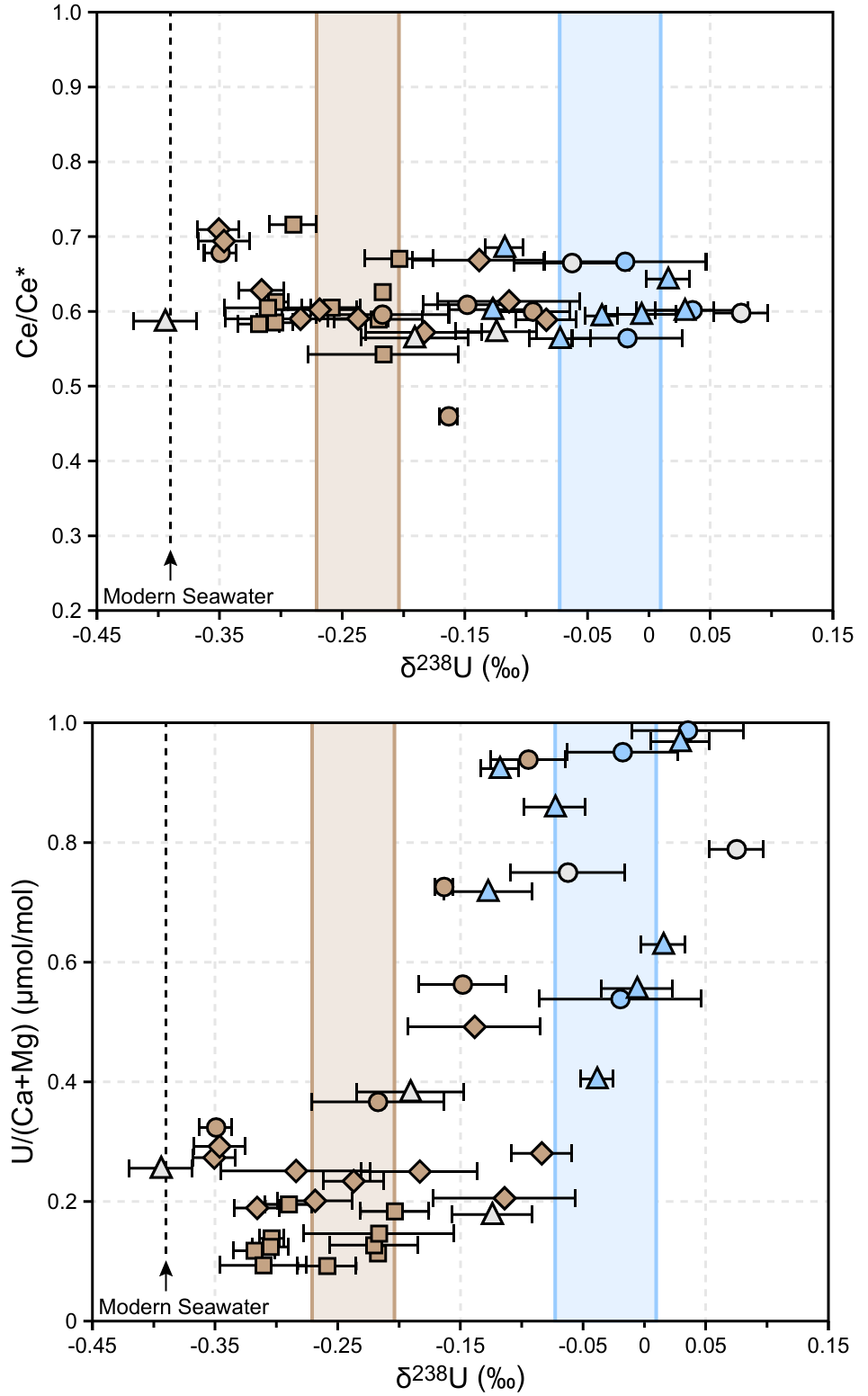
Then we measured uranium isotopes (δ238U) in that same dolomitization front. Despite the pristine petrography and unambiguous seawater-temperature signal, δ238U in the dolostones is offset from both modern seawater and the coeval limestone — a clear diagenetic overprint. Cerium anomalies (Ce/Ce*), measured on the same samples, show no such offset at all. Two proxies, same rocks, same fluid history: one survives, one doesn't — and nothing in the texture or the clumped-isotope temperature would have warned us which.

That result rules out a “universal” diagenetic correction and argues for testing each proxy against a known system like this one before trusting it in deep time, where no such independent check is available.

Key Figures

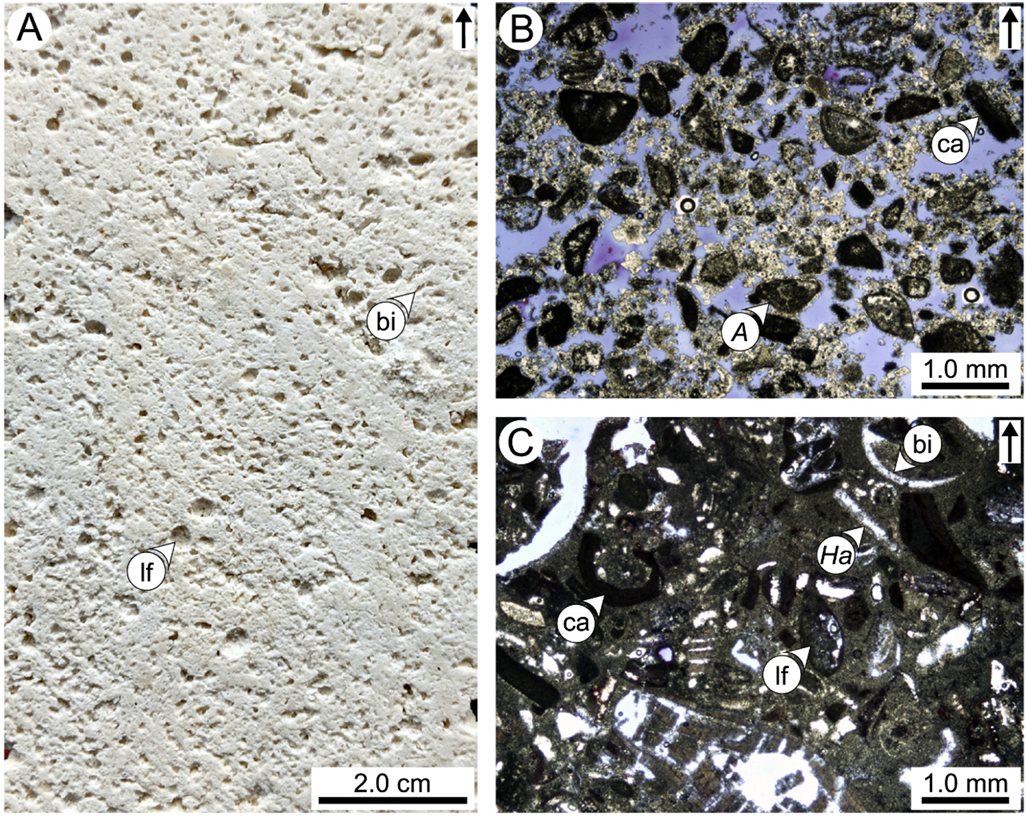
Core photograph and thin-section photomicrographs of dolomitized Cayman Formation facies, showing recognizable skeletal grains including bivalves, coralline algae, and large benthic foraminifera despite complete dolomitization.
Core photograph (A) and thin-section photomicrographs (B–C) of dolomitized Cayman Formation facies: original skeletal grains — bivalves (bi), large benthic foraminifera (lf), coralline algae (ca), Amphistegina (A) — remain clearly recognizable despite complete replacement by dolomite. From Fig. 9, McCormick & Jones (2021), Marine Geology, 436, 106470.
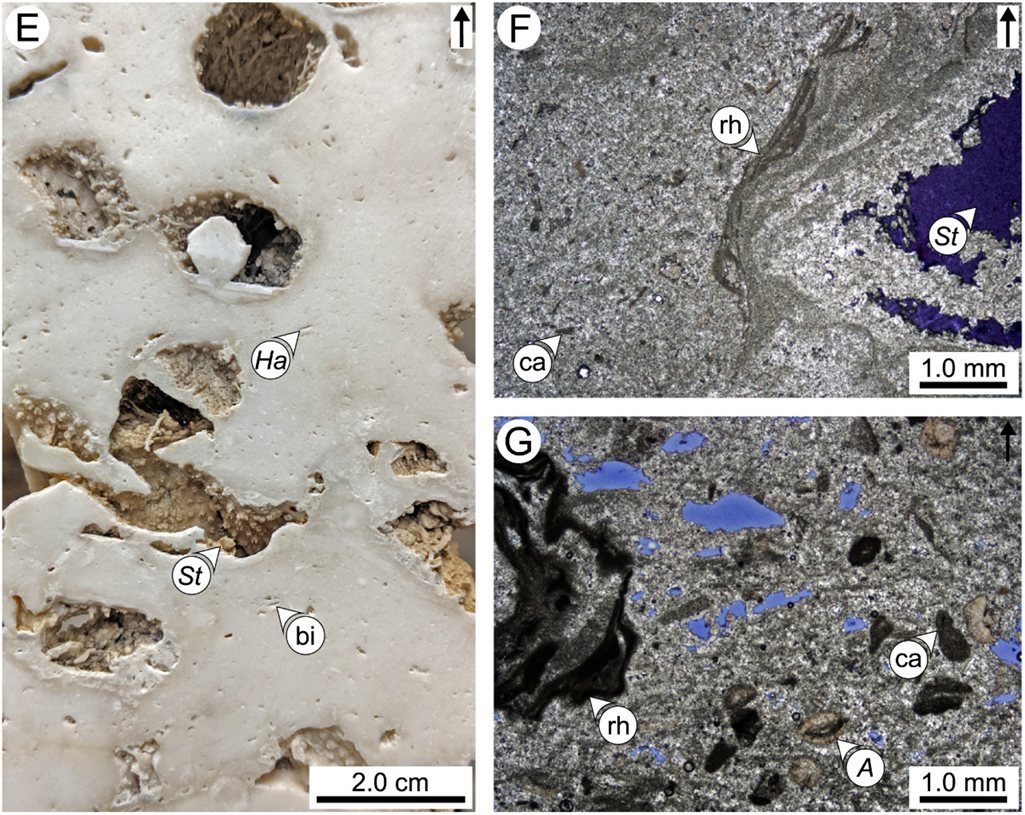
Additional core photograph and thin-section photomicrographs of dolomitized Cayman Formation facies, showing preserved coral, algal, and foraminiferal grains.
Additional core (E) and thin-section (F–G) photographs of the same dolomitized facies, showing preserved Halimeda (Ha), Stylophora coral (St), rhodoliths (rh), and coralline algae (ca) — fabric-retentive dolomitization that leaves the original depositional texture intact. From Fig. 9, McCormick & Jones (2021), Marine Geology, 436, 106470.
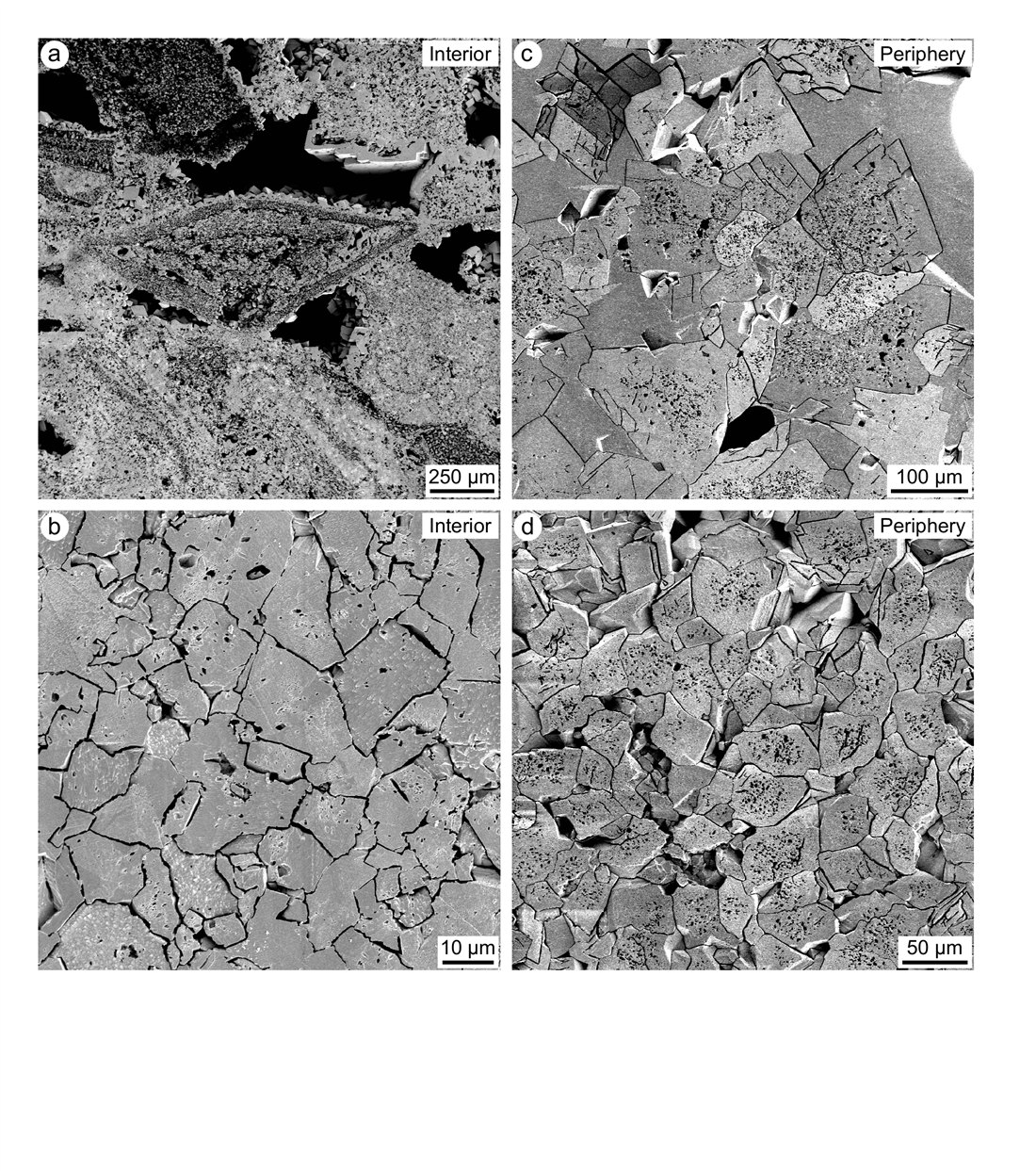
SEM images of dolomite crystals from the interior and periphery of Grand Cayman, showing clean, well-ordered crystal faces with minimal secondary alteration.
The same story at much higher magnification — SEM petrography of Grand Cayman dolomite, interior (a–b) and periphery (c–d): clean crystal faces and minimal secondary alteration, from hand sample down to the micron scale. From Fig. 4, McCormick, Jones, Olsen & Ingalls, Carbonate clumped isotopes (Δ47) in Cenozoic ‘island dolostones’ (In Press, Geochemistry, Geophysics, Geosystems).
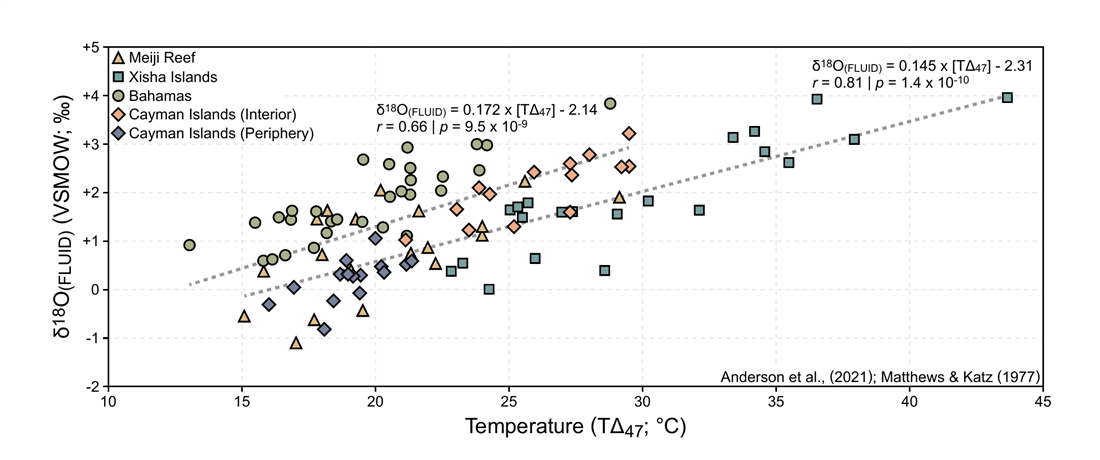
Plot of fluid oxygen isotope composition versus clumped isotope temperature, showing Cayman Islands periphery samples plotting within the normal seawater range alongside other global island dolostone localities.
Clumped-isotope temperature (TΔ47) versus diagenetic fluid composition (δ18OFLUID): the Cayman “periphery” samples (dark blue diamonds) cluster at low temperature and near-zero δ18OFLUID — a normal-seawater signature — distinct from the warmer, evaporated “interior” samples (orange). From Fig. 7, McCormick, Jones, Olsen & Ingalls, Carbonate clumped isotopes (Δ47) in Cenozoic ‘island dolostones’ (In Press, Geochemistry, Geophysics, Geosystems).
Crossplot of cerium anomaly versus uranium isotope ratio, showing dolostone and limestone samples overlapping in cerium anomaly value regardless of rock type.
Cerium anomalies (Ce/Ce*) survive dolomitization: dolostone and limestone samples overlap at Ce/Ce* ≈ 0.6 regardless of rock type. Colors: tan/brown markers and the tan shaded band are dolostone samples and their 95% confidence interval; blue markers and the blue shaded band are limestone samples and their 95% confidence interval; the dashed line marks modern seawater. Shapes denote individual wells (GFN-2, HRQ-2, EEV-2, RWP-2). From Fig. 2C, McCormick, Jones, Hardisty & Lau, Decoupled behaviour of cerium anomalies and uranium isotopes during dolomitization (In Prep).
Crossplot of uranium concentration normalized to calcium and magnesium versus uranium isotope ratio, showing a wide, overlapping spread between dolostone and limestone samples.
Uranium concentration (U/(Ca+Mg)) versus δ238U: unlike Ce/Ce*, both concentration and isotope ratio scatter widely and overlap between dolostone and limestone, underscoring that δ238U carries a diagenetic signal that concentration alone doesn't reveal. Colors: tan/brown markers and shaded band are dolostone samples and their 95% confidence interval; blue markers and shaded band are limestone samples and their 95% confidence interval; the dashed line marks modern seawater. Shapes denote individual wells (GFN-2, HRQ-2, EEV-2, RWP-2). From Fig. 2D, McCormick, Jones, Hardisty & Lau, Decoupled behaviour of cerium anomalies and uranium isotopes during dolomitization (In Prep).

Selected Publications

McCormick, C.A., Jones, B., Olsen, E.K., Ingalls, M. (In Press). Carbonate clumped isotopes (Δ47) in Cenozoic ‘island dolostones’. Geochemistry, Geophysics, Geosystems.

McCormick, C.A., Jones, B., Hardisty, D.S., Lau, K.V. (In Prep). Decoupled behaviour of cerium anomalies and uranium isotopes during dolomitization. Geology.

McCormick, C.A., Jones, B. (2021). On the efficacy and limitations of isolated carbonate platforms as “oceanic dipsticks” to reconstruct subsidence histories, a case study from the Paleogene to Neogene strata on Grand Cayman and Cayman Brac, BWI. Marine Geology, 436, 106470.